
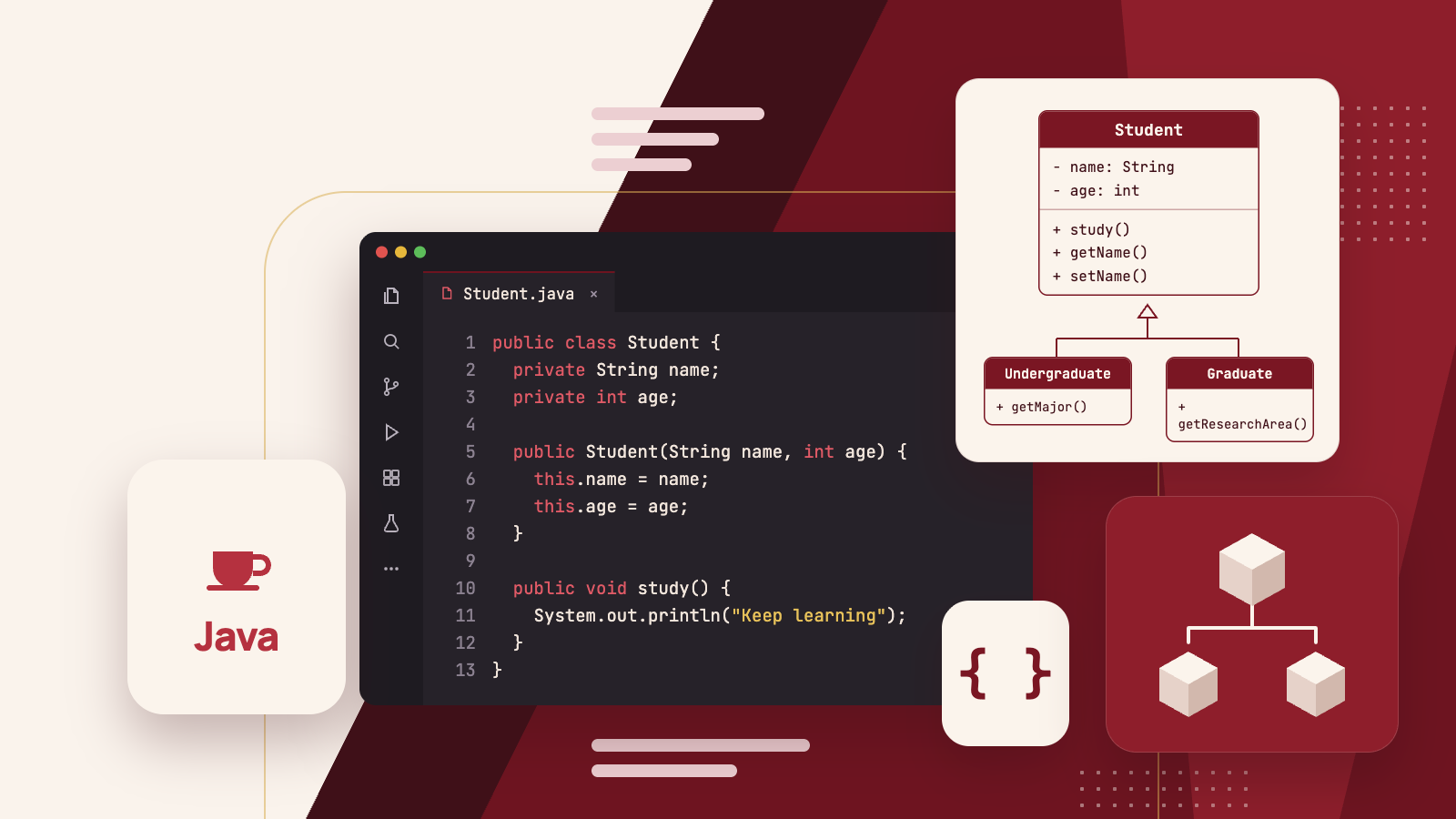
Kurssin yleiskatsaus
Learn Java with a Strong Engineering Foundation
Learning Java is not just about memorizing syntax or getting code to compile.
Strong software engineers learn how to break problems into smaller responsibilities, model software clearly, reason about trade-offs, and write code that remains understandable as applications grow.
Java & Object-Oriented Programming Foundation is designed to help you build that foundation from the beginning.
Across 11 modules and more than 100 lessons, you will progress from Java fundamentals to object-oriented design, practical software modeling, refactoring, and increasingly realistic programming problems.
The goal is not only to teach you what code to write, but to help you understand why a solution is designed that way.
Who Is This Course For?
This course is suitable for:
- Beginners starting their programming journey
- Developers moving to Java from another programming language
- Learners who want to strengthen their Java and OOP fundamentals
- Anyone preparing to move into Java backend development and Spring Boot
No previous Java or object-oriented programming experience is required.
The course begins with the fundamentals and gradually introduces stronger programming and software-design concepts.
Go Beyond Java Syntax
Knowing Java syntax is important, but syntax alone does not make someone a strong developer.
Throughout the course, you will also learn how to reason about software.
You will explore questions such as:
- How should a larger problem be divided into smaller responsibilities?
- Which object should own a particular behavior or piece of state?
- When does an abstraction make a design better?
- When is a simpler solution the better choice?
- How can code remain understandable as an application grows?
- How do you recognize unnecessary complexity?
Object-oriented programming is taught in the same way.
Instead of simply memorizing concepts such as encapsulation, inheritance, polymorphism, and abstraction, you will learn:
- Why these concepts exist
- What problems they help solve
- Where they are useful
- What trade-offs they introduce
- When they should not be used
The focus is on developing judgment, not memorizing patterns.
Learn by Building and Reasoning
The course progresses step by step.
You will begin with small programming problems and gradually work toward applications involving multiple classes, objects, relationships, abstractions, and collaborating components.
Throughout the course, you will work with:
- Practical coding exercises
- Predict-the-result challenges
- Knowledge checks
- Software-design questions
- Refactoring exercises
- Hands-on projects
- A larger final project
You will learn to evaluate more than whether your code works.
You will also learn to ask:
Is this code clear?
Are the responsibilities in the right place?
Will this design be easy to change?
Am I introducing complexity that I do not need?
That shift in thinking is where programming starts to become software engineering.
What You Will Learn
You will build a foundation in:
- Programming logic and problem solving
- Variables, types, expressions, and control flow
- Methods and program structure
- Arrays and data processing
- Classes and objects
- Constructors and object state
- Encapsulation and invariants
- Object relationships
- Composition and delegation
- Immutability
- Packages and project organization
- Inheritance
- Method overriding
- Runtime polymorphism
- Abstract classes
- Interfaces
- Dependency design
- Constructor injection
- Refactoring and maintainability
The emphasis throughout the course is on understanding the reasoning behind these concepts rather than copying patterns mechanically.
Learn in English — Translate with AI When You Need It
The course is written in English, using the terminology you will encounter in professional Java documentation, APIs, technical articles, codebases, and engineering teams.
Java keywords, APIs, class names, method names, and technical terminology remain consistent with industry usage.
If English is not your preferred learning language, Tarkev's AI-assisted translation allows you to translate lesson content into a supported language while you learn.
This can help you understand difficult explanations in a language that feels more comfortable while keeping you connected to the original English technical terminology.
You learn from the same course and can use translation whenever it helps.
Build the Foundation for Java Backend Development
This course intentionally focuses on Java and software-engineering fundamentals before introducing frameworks.
Frameworks such as Spring Boot become much easier to understand when you already know the language and the design principles underneath them.
By developing these fundamentals first, you will be better prepared to understand concepts such as:
- Dependency injection
- Application architecture
- Service boundaries
- Domain modeling
- Data access
- API development
- Testing
- Backend application design
After completing this course, you will have the foundation needed to continue into Java backend development and Spring Boot.
By the End of the Course
After completing the course, you should be able to:
- Build Java programs independently
- Read and understand existing Java code
- Break larger problems into smaller responsibilities
- Model problems using classes and objects
- Use encapsulation, inheritance, interfaces, and composition intentionally
- Organize Java applications more clearly
- Reason about maintainability and code quality
- Refactor unnecessarily complicated code
- Make better design decisions as applications grow
- Approach Java backend development with stronger fundamentals
Most importantly, you should begin thinking about code not only as something that needs to work, but as software that other people—including your future self—need to understand, change, and maintain.
Learn Java. Understand the reasoning behind the code. Start building software like an engineer.